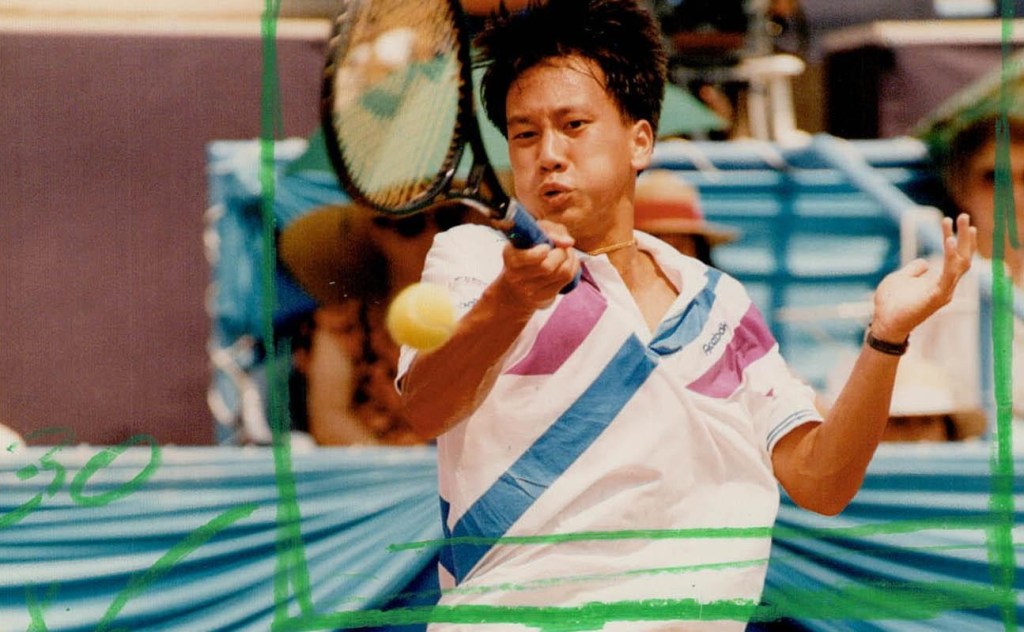

In 1985, the tennis world changed seismically when a young Boris Becker won Wimbledon with a power game that shook the sport. Most professional tennis players were already trading their smaller wooden rackets for graphite-composite midsize frames, and other players cast from the same power mold as Becker—Agassi, Courier, and Sampras, just to name a few—would thrive in the new game. Yet one player, who did not have the same power or height as those players, made his own mark in modern tennis: Michael Chang. I have always been an enthusiastic fan of Michael Chang because, to me, he is a model of turning defeat into victory, weakness into strength, and, above all, of always improving—even today as a coach. Below are some thoughts about his successful career and what it taught me.

Flight of Icarus
The year 1989 had been outstanding for Michael Chang. In June, he became the youngest man ever to win the French Open, at just 17. He had also been selected to represent the United States in the Davis Cup. Then, as the year was ending, during a practice session in Florida on Wednesday, December 6, Chang ran deep to return a backhand, heard a loud crack, and collapsed to the ground. He managed to limp off the court, but an X-ray revealed a hip fracture more commonly seen in 70-year-old men than in 17-year-old professional athletes. As he waited to meet with a specialist, Chang anxiously worried whether he would ever play professional tennis again, let alone have a chance to defend his French Open title. Most of all, Chang wondered how he could have fallen from such lofty heights: one day, Tom Gorman, captain of the U.S. Davis Cup team, phoned him to play for his country; the following day, his entire tennis career was in jeopardy. As the myth of Icarus reminds us, “to fall is to have once soared.”
It’s not failure, it’s feedback
Often, when we think of great athletes, we remember their triumphs but seldom their defeats. The year before Chang’s 1989 French Open win, Ivan Lendl beat him at a tournament in Iowa and, after shaking hands, bluntly offered Chang the following criticism: “First off, you’ve got no serve. And you’ve certainly got no second serve. You can’t hurt me. You can run, but you better develop a weapon to survive out here.” Yet it was in this defeat that the seeds for Chang’s 1989 triumph were planted. Chang focused intensely on improving those aspects of his game, turning that defeat into a lesson that would eventually bear fruit in victory. Lendl’s words may have seemed like pouring salt on a wound at the time, yet, as the great Billie Jean King once said, “It’s not failure, it’s feedback.”

Turning your weakness into a strength
Three years ago, I noticed that every time I hit with my forehand, the ball would sail out of control. Both my brother Martin and my friend Colin, whom I often play tennis with, suspected I had tennis elbow. When I saw a physiotherapist, I was diagnosed with a pinched nerve in my wrist and golfer’s elbow. Despite following all the rehab exercises daily, my forehand was not getting any better—until one day I decided to use a two-handed forehand again. During my teens, I got a Wilson Sting racket that was so heavy I had to use two hands on both sides to hit the ball effectively. Interestingly, my tennis game improved. I had never hit with so much accuracy and power. However, as I got stronger in my twenties, I went back to hitting a one-handed forehand.
Now, thanks to returning to the two-handed forehand, both my tennis improved and my pinched nerve and golfer’s elbow went away. However, I had less reach, so Martin, an exceptional tennis player, recommended that I use a longer racket, which I did. Martin helped turn my weakness into a weapon. This reminded me how, in the 1990s, Chang collaborated with Prince to design a longer racket to improve both his reach and his serve so he could keep up with the new power game of Agassi, Becker, Courier, and Sampras. Chang could have easily rested on the laurels of his 1989 French Open trophy, yet instead he kept moving forward and improved significantly over his career, making it to the finals of both the U.S. Open and the Australian Open in 1996.
The Canadian Open
Chang would recover from that hip injury, and in 1990 he would win the Canadian Open. Over the years, I have attended the Canadian Open and enjoyed watching the matches at the National Tennis Centre. In fact, just a few weeks ago, I went to the Canadian Open—now known as the National Bank Open—which featured a match between Canada’s Leylah Fernandez and Mexico’s Renata Zarazúa. It had not been a good week for Canadian professional tennis, since every Canadian singles player had already lost or withdrawn due to injury just before Fernandez took the stage in Toronto. As Fernandez walked onto the court, her father and coach, Jorge, exclaimed, “You are the last Canadian standing!” Fernandez must have taken this fact to heart, winning the match convincingly, 6-2, 6-2.
During the break, I went to get some snacks. In the lineup, I could hear a couple talking about the match. “Leylah is playing amazingly, and she is doing something new—attacking the net. However, she plays Mirra next, so her run might end there.” The partner enthusiastically replied, “Are you kidding? Leylah is the Michael Chang of the women’s tour. She might win that match!” Two days later, in an upset of Michael Chang proportions, Fernandez would defeat the reigning French Open champion, Mirra Andreeva, 6-1, 6-4.
The next few days, I kept thinking about the comparison to Michael Chang. Fernandez and Chang are similar. Like Chang, Fernandez has hard-working immigrant parents. She is generally viewed as a quick-footed counterpuncher, also like Chang. Finally, Fernandez recently changed her game by adding more net play, which reminds me of how Chang evolved as a player throughout his career. Chang was always moving forward, and today so is Fernandez.

The wisdom of Arthur Ashe
Today, more Asians are playing tennis than ever before. I cannot help but think that Chang was a catalyst for this shift. Chang was more than a professional tennis star; he was an ambassador for the Chinese American community. In a letter to Chang, the great Arthur Ashe reminded him that, as a minority, he had a responsibility to his people, and that, as a fellow person of colour, he supported him. Ashe went on to warn Chang that people would hold him to a higher standard as a minority: “Do you think I, being Black, would have survived 10 minutes if I had acted like John McEnroe?” Certainly, Chang encountered racism as a trailblazer in tennis, yet, as always, he did not let this obstacle stop him.

If you are not moving forward, you are moving backwards
Years ago, I worked for a startup company, and my boss would often say, “If you are not moving forward, you are moving backwards.” At the time, I did not fully understand what that meant. Only later did I realize that in a field based on innovation, the status quo means everyone else moves ahead and you are left behind. Chang’s game relied heavily on his speed and defensive counterpunching abilities, but as the game evolved and embraced power, Chang had little option but to adapt if he wanted to avoid moving backwards. At 5 feet 9 inches tall, he was at a disadvantage against competitors who were all at least 6 feet tall. The longer racket helped, yet there were other aspects of his game that Chang improved throughout his career.
There are many ways we can choose to remember Michael Chang. We can choose to remember him as the 17-year-old teen who won the French Open. Or we can choose to remember him as the first Asian tennis superstar. I choose to remember the tennis player who overcame a near career-ending hip injury and constantly changed and adapted his game, allowing him to be steps ahead of his rivals.


Leave a Reply