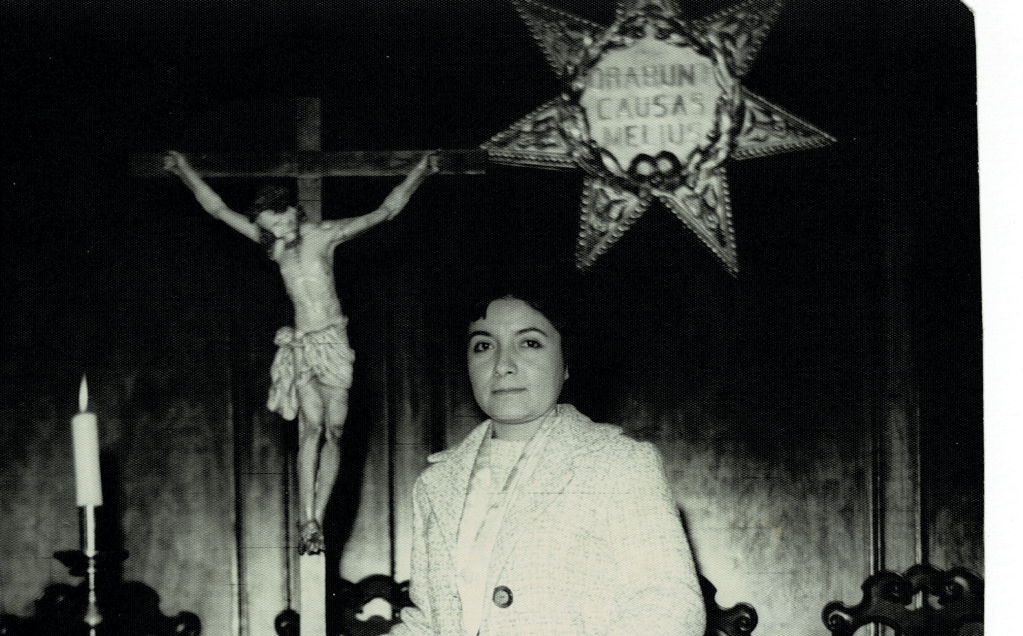
One of my earliest memories is sitting in the back of my parents’ car while Mom drove. She suddenly pulled over. A police officer stopped behind us, walked up, and spoke with her. They exchanged pleasantries. She smiled, calmly and composed. I don’t remember why he waved her over or what she said. It was something minor, and her explanation sounded perfectly reasonable. He ended with, “You are a good driver; next time, just be a bit more careful, Madame.” No fine. No ticket.
As a child, I often wondered who this person was who could talk her way out of a traffic ticket. Whenever she dealt with authority, she stayed calm, confident, and unshaken. How did she learn that?
Years later, visiting my grandparents, I found myself flipping through old family photos with them. One picture stopped me. Our mother was impeccably dressed, about to be admitted to the Bar Association of Peru. Behind her was its motto in Latin: orabunt causas melius (defend just causes). Suddenly, her poise—and her gift for persuasion—made more sense. The photo was from 1962, years before my brothers and I were born, years before she became a mother. My grandmother looked at me, proud of her daughter, and said, “mi Josecito, tu mamita Sarita linda es abogado (my dear José, your beautiful mom Sarita is a lawyer)”.
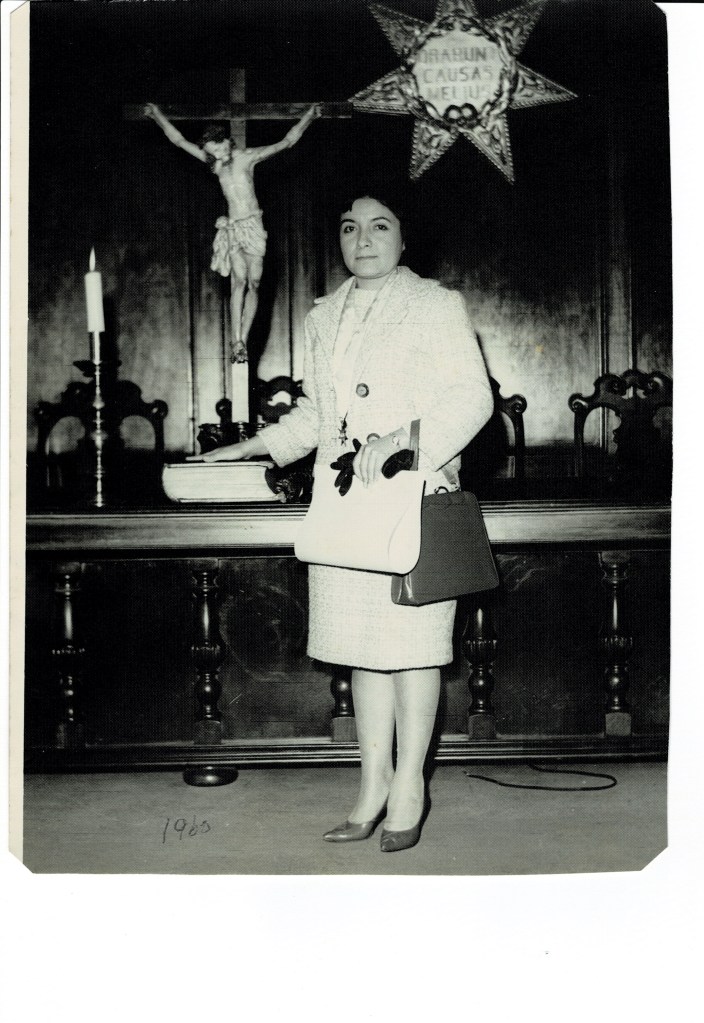
Sarita goes to San Marcos University Lima, Peru (1954 – 1962)
After I learned that our mom was a lawyer, I often asked her at the dinner table what it had been like to study law at San Marcos University during those tumultuous years. Two moments shaped her time there: the Grad Ball and her exchange trip to Indiana University. What follows are her stories as I remember them.
The Grad Ball is announced – San Marcos University (November 1961)
When word spread that the law students’ social committee—mostly wealthy students—had booked an exclusive, expensive club for the Grad Ball, Luis shook his head. One of the few Afro-Peruvian law students at San Marcos, he worked multiple jobs just to stay in school. His family and neighbours in La Victoria had been proud when he was accepted to San Marcos; now he wondered how the cost of their own graduation celebration could shut him—and so many others—out. He spotted his classmate Amalia walking toward him, visibly upset.
“Can you believe what los pitucos (the wealthy students) on the social committee did, Lucho?” Amalia said.
“None of this surprises me, Amalita. They chose El Country Club to keep us out,” Luis replied. By “us,” he meant the working-class students who filled San Marcos then—Indigenous, Afro-Peruvian, Asian Peruvian, and mestizo (people with both Indigenous and Spanish roots) classmates.
Amalia was Peruvian of Chinese origin. Her ancestors had arrived from Macau with almost nothing and worked long hours so that, one day, someone in their family might become a professional, maybe even a lawyer. She was proud of those humble roots, and being the first in her family to attend university mattered to her. This news felt like an affront.
“The only good news is that some of us asked Sarita Sánchez to get us a meeting with the committee. She’s intelligent, kind, and gets along with everyone—even los pitucos. When I miss class because of work, she always lends me her notes. Do you know her, Amalita?” Luis asked.
“Sarita? Of course—she’s my best friend. And trust me: she’s determined, and she knows how to persuade people.”
“That makes me happy, Amalita. And before I forget—I have Sarita’s notes from international law. Please return them to her later today; I need to get back to work.”
The exchange trip to Indiana University, Bloomington Campus (1959)
In 1959, Sarita received a scholarship for an exchange program between San Marcos University and Indiana University. Twenty students travelled from San Marcos with her to Indiana. The trip opened her eyes. She saw racial segregation and its effects on the Black community in the US. Lima had discrimination, but in the 1950s it wasn’t as overt as what she witnessed in the United States. By 1959 Indiana University had ended official segregation, yet unofficial barriers remained: Black students were admitted, but fraternities, sororities, and social clubs often excluded them.
Her parents were proud. Both were Andean (in Peru, Andean refers to people from the highlands, usually with Indigenous roots) and had endured being called serranos (similar to Andean, but can be derogatory) in the tenement where they lived in the working-class district of Barrios Altos. Sarita never treated the word as an insult. She was proud of her roots, and when she saw Indigenous Peruvians excluded, she felt as if her own ancestors were being pushed aside.
One day on the way to the cafeteria at Indiana University in Bloomington the main campus, Sarita noticed the Black students seated apart. White students avoided sitting near them. Back in Lima, university students ate together regardless of skin colour. So, she joined the Black students for lunch and listened to their stories.
The meeting with the law students social committee – San Marcos University (December 1961)
When Manolo arrived early morning at the café across from the university he found Amalia, Luis, and Sarita already seated, waving him over. He liked Sarita. She grew up in Lima, but like him, she had Andean parents—and she was proud of it. Her father was from Apurímac, not far from Huancavelica, where Manolo was born.
Amalia smiled. “Manolito, what a pleasure to see you. I’ll ask Uncle Wong to make you one of his sandwiches.”
The café was famous for pan con chicharrón (cured pork sandwiches with salsa criolla and lettuce). Ordinary people ate there. Missing, noticeably, were students from San Isidro, Miraflores, and Lima’s wealthier districts. Manolo wondered where los pitucos had breakfast. As he ate, he decided it was their loss.
After breakfast, they walked to the law faculty to meet the social committee as requested by Sarita. The committee was already waiting for them in a room near the library. Cecilia, the chair—a banker’s daughter—began to speak.
“First, I must thank Sarita for organizing this meeting. As you know, the law faculty at San Marcos has a long tradition of celebrating graduation in a place that is stylish and decent. We only graduate once, so it should be special. We also want the celebration to be in a safe neighbourhood. I understand that holding it at El Country Club may be expensive for some, but we encourage anyone with economic limitations to get a loan—this is a Grad Ball no one should miss. Now, Sarita, please say a few words on behalf of your classmates.”
“Muchas gracias, Ceci. It’s interesting you call this club ‘decent’. I brought a few newspaper clippings. They describe allegations of drug use at parties there, and reports that some men bring lovers there—and sometimes even hired escorts. I also spoke with the Guardia Civil (police), and they are considering pressing charges. As future lawyers, we’re about to enter a profession built on ethics. We cannot hold our graduation celebration in a place whose members are facing allegations of indecent conduct.”
Manolo realized Sarita had turned the tables. Cecilia looked shaken, fighting back tears.
Cecilia, nearly hyperventilating, replied, “You’re calling us indecent, Sarita.”
Manolo and his Andean classmates had long bristled at how Lima’s elites called themselves la gente decente (the decent folks) to justify privilege and discrimination. In their world view, only the wealthy were ‘decent,’ and everyone else was not. Now Sarita challenged that bias in front of their richest classmates. People had excused the behaviour of los pitucos for years. Not today. Sarita was forcing the committee to answer for its choice.
“Ceci, I’m not insulting anyone. I respect you and the committee and the work you do. I’m only saying this club is clearly problematic. If safety is the concern, there are plenty of affordable halls in the historic district. Why don’t all guests step out now so the committee can vote on another location?”
Cecilia nodded. Manolo, Sarita, and their friends stepped into the hallway. The vote was quick. Within minutes, Cecilia opened the door, looking almost relieved.
“The committee voted to cancel the contract with El Country Club. Luckily, it’s early, so there are no penalties. We’ll look for another hall in the historic district—maybe El Club Italia—and I’ll keep you informed, Sarita. And here are your contract law notes you graciously lent me the other day. Thank you. Chao, everyone.”
Manolo smiled to himself. Sarita would be a clever lawyer. Without accusing anyone of discrimination, she’d gotten the committee to do exactly what everyone wanted. How did she know so much about El Country Club? Was she bluffing about the charges? Probably not. Maybe she’d received an “anonymous tip,” especially if her father was in the Guardia Civil.
Reading Conversation in the Cathedral – Scarborough Bluffs (Summer 1995)
When we moved to Canada, I started reading the great works of the Latin American literary boom to keep my Spanish. I began with shorter novels, like The General in his Labyrinth by Gabriel García Márquez. Eventually, I took on Conversation in the Cathedral by Mario Vargas Llosa—a classic of modern Hispanic literature. Set in the 1950s during the Odría dictatorship, it follows three San Marcos law students—Adía, Jacobo, and Zavalita—as they form a communist cell. The novel unfolds in the same era when our mother was studying law there. She even knew Vargas Llosa at San Marcos, when he studied law and literature and was known, she told me, as Varguitas.
Conversation in the Cathedral captivated me. On weekdays I couldn’t wait to get home from work to read the next chapter. One night after dinner, I told Mom about a character in the novel Jacobo—a wealthy law student disowned by his rich family for becoming a communist—and his love for Adía, a working-class student. Mom looked at me and said, “I know them, hijito (my son)—they were my classmates Félix and Lea!” That didn’t surprise me; Vargas Llosa often shaped characters from real people. Mom told me Félix belonged to the Arias-Schreiber family, part of Lima’s aristocracy, and that he was cast out for his politics. Years later, I read a Peruvian article in which Vargas Llosa admitted Adía and Jacobo were loosely based on his close friends Lea and Félix. They never abandoned their leftist beliefs. Vargas Llosa did, eventually, embracing liberalism—but the three friends remained bound by mutual respect for the rest of their lives.
Through that novel, I began to grasp what our mom must have lived through at San Marcos: daily protests, clashes with paramilitary police, classmates arrested. And above all, a campus that, in huge numbers, opposed the dictatorship and—like her—dreamed of a Peru without discrimination and oppression.
The night of the Grad Ball – Lima Historic District (February 1962)
When Félix arrived at the banquet hall with Lea, he noticed the social committee hadn’t shown up. None of the students from Lima’s wealthiest districts were there either. Instead, the room belonged to the popular districts: people dancing, eating, mingling. Félix corrected himself—he was the only one with a wealthy background at the ball, but his family had long ago banished him and cut him from their estate.
Félix’s parents never wanted him at San Marcos. In his upper-class neighbourhood, people called it the university of los cholos (a term that can be derogatory for people of Indigenous roots in Peru, depending on context). They pushed him toward La Católica (the Catholic University of Lima), back then seen by elites as the school for la gente decente. Félix would answer, “I want to meet students from all the corners of Peru, not just the people from our neighbourhood.” That night, looking around the hall, he saw his wish come true: Andean classmates like Manolo, Afro-Peruvian students like Luis, Asian Peruvian students like Amalia, and others with European roots, like Amalia’s boyfriend Roberto, whose father had immigrated from Bavaria before the war.
Así debemos ser todos mezcladitos (we should all be this diverse), Félix thought to himself.
Félix heard rumours that his family had disowned and disinherited him for joining a communist cell at San Marcos with Lea and Varguitas. The truth was crueler: they couldn’t forgive that he loved a woman of humble origins. He even overheard old neighbours sneer, “How can he be with that huachafa (in Peru, this term is derogatory for a person of modest beginnings trying to appear wealthy or sophisticated)?”
Lea leaned in and said, “Before we dance, let’s thank Sarita for making this night possible.”
Over the years, Félix carried the pain of being cast out by his family—and by the friends he’d grown up with. But now, largely because of Lea, he had found a new family: friends from the law faculty at San Marcos.
Tell her stories – the Junction, Toronto (June 2023)
Mom told me the Grad Ball story years ago, but she never wrote it down. It stayed with me. Before starting a successful career as a lawyer, she had already broken barriers in a simple graduation celebration and that mattered. When she passed away in 2023, I couldn’t tell this story without choking up. At her funeral, I said what I could: that she believed in fairness and inclusion, that her thesis on agrarian land reform showed pride in her Andean origins. But I couldn’t say much more. It took me three years to speak of it. I once considered reaching out to her classmates for their version of these stories, but Amalia, Félix, Lea, Luis, Manolo, and Roberto had all passed away long ago. Our mother outlived them. So, I did what Varguitas would have done: I gathered what I knew, and where the story had gaps, I imagined the rest as it might have unfolded—through the eyes of her friends.
Growing up, I would always go to dad who is an electrical engineer for math and science questions, and when I had questions about ethics and values, I would go to mom who I affectionately called ‘my lawyer’. In her own way she always guided me to do the right thing time after time without pushing me in any direction. Even today, while she is not with us anymore, I can hear her voice asking me to help others, especially those in need and anyone treated unfairly.
At her funeral, my cousin Pedro hugged me and said, “Hey primo (cousin), tell her stories.” In the months and years that followed, I tried to do exactly that. Everything I’ve written since she passed has some connection to her life. While drafting this piece, I reread notes she left from her exchange trip to the Bloomington campus of Indiana University and found her words: “perhaps because of my own humble origins I was always more than willing to take the side of the underprivileged and those discriminated against because of the colour of their skin.”


Leave a Reply