
Lost and Found in Pontevedra

Os habéis perdido are three words you would not want to hear along the Camino de Santiago. Basically, they mean “you are lost” or “you have lost your way”. It can happen to any one of us. We all lose our way from time to time. If you lose your way in Pontevedra or anywhere along the Camino, just ask any of the locals how to get back to El Camino. Galicians have been helping orient lost pilgrims for centuries, so their sense of direction by now is better tuned than any GPS. Perhaps, an elder Galician woman will tell you, “Just go back to the main highway to Caldas then go under the bridge and you will see the yellow sign with the shell pointing the way back to El Camino”. And next thing you know, you no longer will be lost and you will be on your way. After all, isn’t it the kindness and generosity of strangers that often helps us find our way again?
The first seal in Tui

This journey began like many journeys do in a frontier. My wife and I decided last year to hike the last 100 kilometers of the Camino Portugués starting from Tui, Spain which is close to the border town of Valença, Portugal. Here people are fluent in Galician, Portuguese, and Spanish. And many speak perfect English. Last week we took the train from Porto to Valença. When we arrived I called a cab and right away I could hear a cellphone ringing. The only taxi driver in town was in front of us all along, he showed us his phone ringing with a smile, grabbed our bags and took us to our bed and breakfast across the river in Tui.
The next morning, we began our journey and when we arrived at the Cathedral of Tui, we would get our first seal for our Camino Pilgrim Passport. I would also light the first candle for a loved one on this journey, this time for our beloved tío Miguel (uncle) who recently passed away. And I thought of the pain my cousins, aunts, uncles, and our dad who were so close to him must be feeling at this moment. Our uncle was a man full of life and had a contagious warm smile that I will always remember.
Hugo Sotil lives in Porriño

During our hike to Porriño, I could not help but notice how much corn was being planted along the way. Corn was domesticated thousands of years ago by the indigenous peoples of what is today southern Mexico. And now it has become a staple food nourishing people in Galicia and all over the world. Also, all along the Camino you can hear Latin American music, such as Bachatas from Dominican Republic, Cumbias from Colombia, and Norteñas from Mexico. And you will find tacos, arepas and other Latino fare in the Camino. Food and music from Latin America have blended in with Galician culture thanks to the Latino immigrants who left their home to live in these lands.
One of these Latino immigrants who lived in Spain was the great Peruvian football star Hugo Sotil who played for Barcelon FC 1973 through 1976. Sotil one of the first South Americans to play for Barca was a true trailblazer. His beautiful dribbling, passing and creative playmaking are remembered to this day by fans all over the world.
When we went to a church in Porriño to get our seal, I noticed a man vacuuming the office of the church. I asked him, “where is the priest?” “I am the priest”, he replied as he started to personally seal our Pilgrim Passports. “You are Canadian, but you speak perfect Spanish, why is that?”, he told me. “I was born in Peru”, was my answer. He looked at me straight in the eyes, put his arm on my shoulder, and with a serious tone he told me, “Well, I have something important to share with you. With you being so Peruvian and me being such a futbolero (football fan): ¡Que viva Sotil!”
Que viva means “long live” or “hooray for”. Hugo Sotil passed away on December 29, 2024, yet for a moment he was alive and well in our memories in the town of Porriño.
Vigo and Tania

The reason we went to Vigo was to try Pulpo a la Gallega (Galician style octopus). Once there though I was impressed by the number of monuments that commemorated the brutal oppression Galicians suffered during the Spanish Civil War and the Franco years. This oppression resulted in many Galicians leaving Spain for Latin America. In fact, immigration to Latin American countries from Galicia after the Spanish Civil War was so prevalent that the terms Gallego (Galician) and Spaniard became interchangeable in Latin America. In other words, any recent immigrant from Spain was simply assumed to be from Galicia.
One of these immigrants was Tania la Gallega who became a famous Tango singer in Buenos Aires, Argentina. A feminist with great charisma Tania la Gallega was breaking barriers already in the 1920’s long before Madonna appeared on the world stage in the 1980’s.
As I looked at the beautiful port of Vigo, I imagined all those Galician immigrants leaving their home in ships much like those anchored there to escape Fascism and to start a new life in Latin America.
Saved from Sangria in Padrón

Padrón is known as the last stop before reaching Santiago de Compostella. After receiving an invigorating massage from the local RMT we headed towards Filoxera a well-known wine bar downtown. Throughout the trip I had been drinking Sangria at dinner to cool off from the unusual heat in October. When we arrived at the wine bar I asked for a Sangria glass. The sommelier gently responded, “look here, we are a serious wine bar as such we don’t offer Sangria. May I recommend a glass of a local tinto (red)?” Sure, I replied. The local tinto from Meiga was one of the most elegant wines I have ever tried, and the meal was sumptuous. As we left, I thanked the sommelier for the magnificent Meiga and for saving me from Sangria. He replied, “of course we will nunca (never ever) have Sangria here!”
Embracing Santiago

We woke up early to start the last hike to Santiago de Compostella. It was about 26 kilometers and mostly uphill, so we had to start while it was still cool in the morning, and I was very tired and had knee pain.
Exactly, one year ago my wife and I went to Porto for a leisurely relaxing trip, and she bought a book called Camino Portugués, which showed a plan on how to complete the last 100 kilometers of the Camino which would get one a certificate of completion. She told me, wouldn’t it be nice if we completed the Camino. At that time, the plan was just a dream. Yet my wife is a strong-willed person capable of making the most complicated and challenging dreams a reality.
After walking for nearly 8 hours with only a few breaks we reached the outskirts of Santiago de Compostella. We could see Pilgrims already throwing the towel and taking the bus or hailing taxis. Yet my wife persevered, “we are walking until we reach the cathedral”. Fatigue set in, and I was so ready to take the bus, when suddenly I saw a graffiti with the words: dale José (keep going José) that motivated me to finish. An hour later we reached the cathedral of Santiago de Compostella, and we went to the Pilgrim welcome center to receive our last seal.
We saw the tomb of Santiago, and I remembered reading long ago that there is no concrete evidence that he is buried there, yet the sanctity of the place led me to think perhaps it is him who is buried there or at least someone very important to Christians everywhere.
At the Cathedral I lit the last two candles of our trip. One for our wonderful tío Miguel and the other for our beautiful mother who left two years ago and has been on my mind every single day since. Somewhere in the other world they must be smiling.
Marvelous Madrid
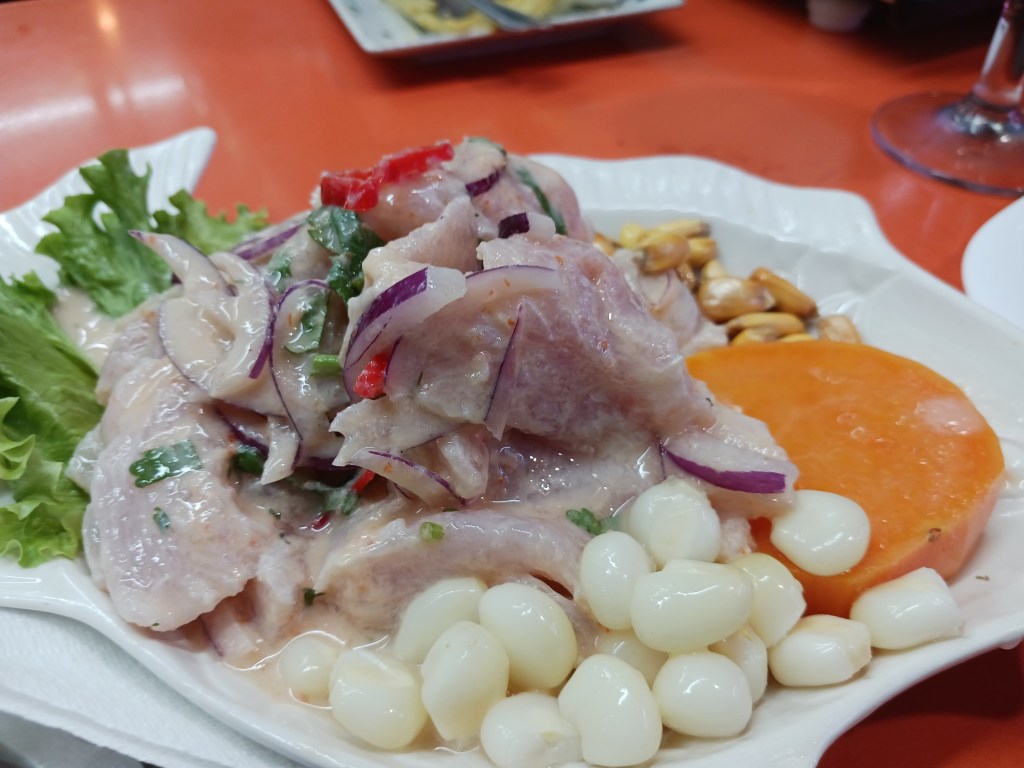
To go back to Toronto, we had booked a flight from Lisbon. We flew from Santiago to Lisbon with a long layover in Madrid. We took this opportunity to go to the Mercado de Maravillas to have Peruvian food for lunch. This mercado is full of Latin American and Spanish food and I highly recommend it for anyone visiting Madrid. When we were about 700 meters from the Mercado the taxi driver jokingly said, “well, I can drop you off here since after walking 100 kilometers surely 700 meters must be nothing for you.”
Lisboa by Night

After lunch we took another taxi to the Madrid airport to catch our flight to Lisbon. This time the driver was an Argentinian man who had immigrated to Spain long ago. He told me how he now considers Spain to be his country. And that Spain gave him opportunities he might never had seen in Argentina. This reminded me how over the years Canada has become my country now that I have lived here longer than anywhere else. And that Canada has given my family and I many opportunities to grow. As he dropped us off, the cab driver told me, “You know all my life I have always been a luchador (a fighter).” I replied, “us immigrants we are all luchadores (fighters).” He smiled and shook my hand.
That night we had yet another sumptuous meal, this time seafood in Portugalia a restaurant that has been in business in Lisbon for over 100 years. Here is to 100 more!
Home again
After landing at Pearson airport the following day we decided to take the UP-train home. And we could see so many people dressed in blue wearing Blue Jays caps and jerseys heading downtown. Of course, tonight is the big game. To me the Blue Jays will always represent home and Canada the noble country that opened its doors to my family and I back in 1982.

 High Park Engineer
Leave a comment